
Vendors are only half the GBOB business — without clients, the best vendor database in the world just sits there unused. Yet client-finding is where most beginners get stuck, cycling through generic “network on LinkedIn” advice that rarely produces real leads. This guide covers how to find GBOB clients using three genuinely different, tactical methods — not networking tips, but specific searches and tools that surface businesses actively ready to buy.
⚡ Quick Summary
- A real client sells something — product, service, course, or tool. A pure content blog almost never converts.
- Transactional keywords + long-tail search surfaces small-to-medium businesses actively investing in SEO.
- Tracing existing guest posts to their outbound links finds businesses already buying backlinks right now.
- Agencies are a force-multiplier — one solid agency relationship can outperform 50 individual client deals.
- Response rates vary a lot by method — knowing which to use when saves serious outreach time.
The best GBOB client isn’t the biggest business you can find — it’s the one already showing you exactly why it needs your help.
How to Find GBOB Clients
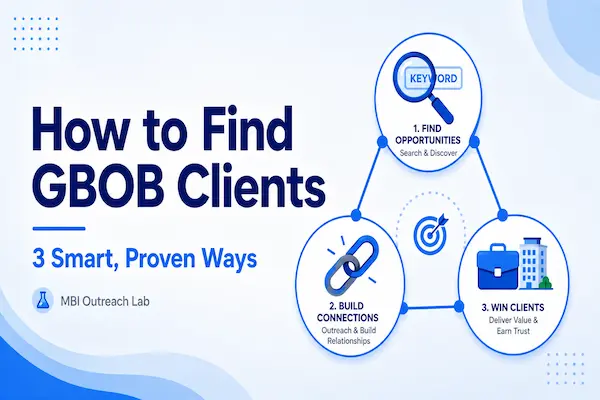
Short answer: find GBOB clients through three methods — targeted transactional-keyword searches for businesses ranking poorly, tracing existing guest posts back to the businesses that placed them, and approaching SEO/marketing agencies directly through directories and lead-generation tools. Each method surfaces a different type of lead, and using all three together builds a much stronger pipeline than any one alone.
What Actually Makes a Good GBOB Client
Before any method works, know what you’re looking for: a site actively selling something — a product, service, course, or tool. A blog with no commercial activity is almost never a viable client, even with a large audience. The clearest signal is keyword intent: sites that use commercial and transactional language (buy, best, pricing, near me) are actively selling; informational and navigational content rarely converts into a client relationship, a distinction Google’s own SEO documentation also treats as fundamentally different search intents.
Method 1: Transactional Keyword Search
Ask an AI tool for a batch of long-tail transactional keywords in a niche where you already have strong vendor coverage — never chase clients in a niche you can’t actually serve. Long-tail phrases matter because they carry lower competition than short keywords, which are dominated by giants like Amazon who’ll never need your services. Long-tail search surfaces small-to-medium sites instead — exactly the businesses that need backlinks.
Search the keyword in Google with an SEO browser extension active and your location set to a target country — US, UK, Canada, Australia, and Europe-based businesses typically spend more on SEO than businesses in lower-cost regions. Look for sites ranking low with a weak authority score: this combination is your ideal target, since you can credibly explain their poor ranking and offer a direct fix. The Semrush shortcut works too — run the same keyword through Keyword Overview, switch to SERP Analysis, view domains, and filter for low authority plus low traffic.
Method 2: Trace Existing Guest Posts to Their Clients
This method targets businesses already actively buying backlinks right now — arguably the warmest lead type available.
Manual version: open a recent post (within the last week, ideally) on a site that frequently publishes guest content. Confirm it’s genuinely a guest post by checking for an external link — click it, and if a new site opens, that’s your potential client. Check that site’s authority; skip anything premium (Forbes-level), and approach anything medium or light with a specific pitch: their current ranking reflects weak backlinks, and you can offer niche-relevant placements to help.
Tool shortcut: in Semrush, pull a vendor site’s Backlink Analytics and open Outbound Domains (not Referring Domains — that’s for finding vendors). Filter by low authority score and sort by “First Seen” to surface the most recent placements first. In Ahrefs, the equivalent is Site Explorer → Outgoing Links → Linked Domains, filtered by domain rating and traffic. Either tool turns a manual, one-by-one search into a five-minute export.
⚠️ Watch for this: this method’s response rate is reportedly roughly double the pure keyword-search method — because you’re approaching businesses with an active, specific, provable reason (their guest post choice) rather than a cold guess. Don’t skip it in favor of the easier keyword method alone.
Method 3: Target Agencies Through Directories and Lead-Gen Tools
This is the highest-leverage method: one working relationship with an SEO or content marketing agency can bring recurring, ongoing orders — outperforming dozens of one-off individual client deals, as long as you deliver reliably.
Business directories (Clutch.co, GoodFirms, and similar) list agencies with revenue range, team size, and hourly rate visible upfront. Rather than using the directory’s own contact form, visit the agency’s actual website and check the footer for a direct email — it typically gets a more genuine response than a generic inquiry form. Pitch collaboration directly: pre-vetted niche data that saves them outreach effort, in exchange for routing their orders through you.
Lead-generation tools like Snov.io, Hunter, and Apollo hold large prospect databases you can filter instead of searching manually. Search by job title (SEO Executive, Link Building Specialist, Content Marketing Manager) plus location and industry to surface decision-makers directly, or search by company to find whole agencies by specialty. Most tools flag whether an email is verified before you spend outreach effort on it — a genuinely useful time-saver.
💡 Pro tip: organize agency leads into country-specific lists (USA, UK, Australia) inside folders from day one. Running focused, country-specific outreach campaigns later is far easier than untangling one giant mixed list.
Comparing the Three Methods
| Method | Response Rate | Best For |
|---|---|---|
| Transactional Keyword Search | Lower (cold) | High-volume outreach at scale |
| Trace Existing Guest Posts | Roughly double Method 1 | Warm leads already spending on backlinks |
| Agency Directories/Tools | Lower volume, higher value | Recurring, long-term revenue |
📊 Combining methods in practice
Illustrative example, not a guaranteed outcome: a practitioner running Method 1 at 500 emails/week might see 2-3 replies; the same volume through Method 2 (tracing guest posts) can realistically double that to 5-6. Layering in just 10-15 targeted agency contacts through Method 3 alongside both, even landing one agency relationship in a given month, can outproduce the entire individual-client volume from Methods 1 and 2 combined over the following quarter — which is why relying on only one method leaves real revenue on the table.
Common Misconceptions About Finding GBOB Clients
“Any Website Can Become a Client”
Only sites actively selling something realistically convert. A pure content blog, however popular, almost never becomes a paying GBOB client.
“More Outreach Volume Always Wins”
Volume matters, but targeting quality (businesses already showing buying signals) consistently beats blasting generic lists — Method 2’s roughly double response rate over Method 1 proves this directly.
“Agencies Are Harder to Land, So Skip Them”
They take more effort upfront, but a single agency relationship can generate more consistent revenue than dozens of individual clients — skipping this channel means leaving the highest-leverage opportunity untouched.
“You Need Paid Tools to Find Clients at All”
Free methods (Google search, manual directory browsing) work — paid tools like Semrush, Ahrefs, or Snov.io simply compress the time investment, they don’t unlock capability you otherwise lack.
Learn More: Lead Generation for Agencies
A closer look at using Snov.io for lead generation — the same tool referenced in Method 3 above.
Ready to Build Your Client Pipeline?
Have questions about which method fits your niche?
Get in touch and we’ll help you figure out where to focus your client-finding effort first.
Frequently Asked Questions
What’s the fastest way to learn how to find GBOB clients as a beginner?
Start with Method 1 (transactional keyword search) since it needs no paid tools — just an AI tool for keywords and Google itself. Add Method 2 once you’re comfortable, since its response rate is meaningfully higher.
How many outreach emails should I send per day?
A steady 50-100 per day, Monday through Friday, is a realistic target that typically produces a solid inquiry within one to two weeks of consistent effort.
Are agencies really better clients than individual businesses?
Often, yes — a single reliable agency relationship can generate recurring monthly orders, versus individual clients who may only order once. Both are worth pursuing, but agencies deserve dedicated effort.
Do I need Semrush or Ahrefs to find clients?
No — the manual method works with just Google and a free authority-checking browser extension. Paid tools save time at scale but aren’t required to start.
What’s the biggest mistake beginners make finding clients?
Pitching pure content blogs with no commercial activity, or relying on a single method instead of combining keyword search, guest-post tracing, and agency outreach together.
Should I focus on one country or many?
One or two, at least initially. Practitioners who stay narrow tend to build deeper expertise and better response rates than those spreading thin across many markets at once.
Final Thoughts
Learning how to find GBOB clients comes down to combining three genuinely different approaches: transactional keyword searches for scale, guest-post tracing for warmer leads, and agency outreach for recurring revenue. No single method covers everything — the practitioners who build a real pipeline are the ones running all three in parallel, not the ones searching for the one perfect tactic.
Related Reading
More from MBI Outreach Lab:
- What Is GBOB? 8 Proven Skills, Honest Guide
- How to Find GBOB Vendors: 3 Proven, Smart Tiers
- GBOB Terms: 14 Easy, Essential Definitions
- GBOB Outreach Emails: Clients & Vendors (coming soon)
