
One email template rarely works for both sides of a GBOB deal. A client needs convincing that a real problem exists and you’re the fix; a vendor just wants a clear, professional ask. Mix up the psychology — or ignore the technical side of deliverability — and even a well-written pitch lands in spam or gets ignored. This guide covers GBOB outreach emails for both audiences, plus the spam-avoidance system that determines whether either email gets read at all.
⚡ Quick Summary
- Client emails need a pain point — a specific problem you noticed, before any pitch.
- Vendor emails can be simpler — most vendors respond to a clear, professional, niche-specific ask.
- Deliverability is a system, not luck — multiple warmed-up accounts, gradual sending limits, and clean first emails all matter.
- Never include links or attachments in a first cold email — both are major spam triggers before any trust exists.
- A CC backup habit protects every deal — if your main account gets blocked mid-negotiation, the conversation isn’t lost.
The best outreach email isn’t the most persuasive one — it’s the one that actually reaches the inbox in the first place.
GBOB Outreach Emails: Clients vs Vendors
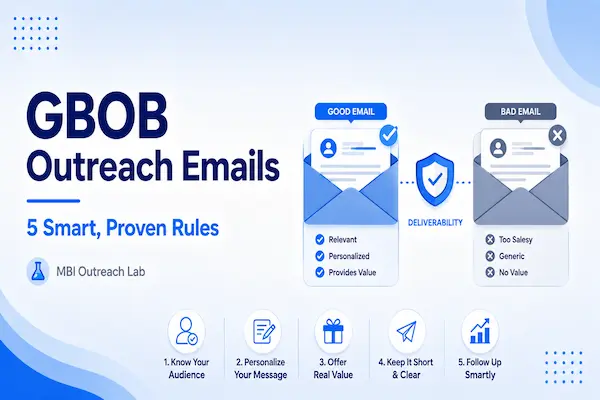
Short answer: client emails need to establish a specific problem before pitching a solution, while vendor emails can be more direct and professional. Both depend equally on a deliverability system — verified addresses, warmed-up sending accounts, gradual daily limits, and clean, link-free first messages — since even a perfectly written email is worthless in spam.
Writing Client Emails: Lead With the Problem
A client email works best in five parts: a pain-point opener referencing something specific about their site, the pain point explained clearly (weak backlinks, poor rankings, being outranked by competitors), your solution (access to relevant, trusted placement sites), light proof (a few example sites ready to show), and a low-friction call to action inviting a quick reply or call.
AI tools draft this well when given full context: who you are, what you have (e.g., a niche vendor network with specific stats), and exactly who you’re targeting, including their specific pain point. Requesting several subject line options first, picking the strongest, then generating the matching email around it produces sharper results than asking for everything at once.
⚠️ Watch for this: avoid the words “guest post” and “backlinks” in a first client email — many recipients have learned to auto-filter messages containing these terms after years of generic pitches. Softer framing (SEO placements, authority partnerships) gets further before trust is established.
Writing Vendor Emails: Simpler, Still Personalized
Vendors in the normal authority range typically respond to straightforward, professional emails — no elaborate pain-point framing required. Still personalize with the specific niche and mention the target blog by name in the subject line; a generic template reads as mass outreach regardless of how nice the phrasing is.
Once a vendor replies, negotiate carefully rather than aggressively — pushing hard on price before there’s a real order in hand wastes goodwill you’ll need later. Frame requests professionally (mentioning you represent multiple clients at an estimated budget, rather than bluntly demanding a discount), and use future volume or content quality as leverage rather than pressure alone.
The Deliverability System That Makes Both Work
Per Gmail’s own sender guidelines, inbox providers actively watch for patterns that resemble spam — which makes a deliberate sending system worth building before volume outreach begins.
- Use multiple accounts, warmed up first. A handful of dedicated outreach accounts, properly warmed up before real sending, spreads volume and reduces per-account risk.
- Start low, scale gradually. New accounts should send conservatively in week one and increase only as engagement proves healthy.
- Keep the first email clean. No links, no attachments, no images — these are consistently flagged as spam signals before any reply exists. They become safe once a real conversation has started.
- Personalize and vary content daily. Identical templates sent repeatedly read as bulk mail to spam filters; light rewording each day meaningfully reduces this risk.
- Keep signatures plain. A simple name-and-role signature is safer than one loaded with links and social icons, which modern spam filters weigh more heavily than they used to.
A Realistic Sending Ramp Schedule
Use this as a starting framework, not a fixed rule — adjust based on your own engagement data:
| Week | Emails per Account/Day | Focus |
|---|---|---|
| Week 1 | ~10 | Warm-up, monitor deliverability closely |
| Week 2-3 | ~20-30 | Gradual increase if engagement stays healthy |
| Week 4+ | ~50 | Working steady-state volume per mature account |
💡 Pro tip: always CC one of your own separate, non-outreach email addresses on vendor conversations. If your outreach account ever gets blocked mid-negotiation, the full conversation history is preserved and you can pick up the deal without starting over.
Common Misconceptions About GBOB Outreach Emails
“One Template Works for Everyone”
Client and vendor psychology differ enough that copying one template across both audiences measurably underperforms tailoring each to its actual reader.
“More Emails Sent Always Means More Replies”
Volume without deliverability discipline just means more emails landing in spam. A smaller, properly warmed-up sending system outperforms a larger, reckless one.
“Links and Attachments Show Professionalism”
In a first cold email, they do the opposite — both are strong spam signals until a real reply exists. Save them for the second message onward.
“Aggressive Negotiation Gets Better Vendor Prices”
Pushing hard before a real order exists mostly burns goodwill. Professional, patient framing consistently gets further with vendors than blunt demands.
Learn More: Cold Email Deliverability in 2026
Updated deliverability rules directly relevant to the sending system covered above.
📊 Why the ramp-up matters
Illustrative example, not a guaranteed outcome: a beginner sending 50 emails/day from a brand-new, un-warmed account in week one commonly sees deliverability collapse within days as spam complaints accumulate. The same volume, reached gradually over 3-4 weeks from a properly warmed account, tends to sustain healthy delivery rates far longer — the schedule isn’t caution for its own sake, it’s what keeps an account usable past the first month.
Need Help With Your Outreach System?
Have questions about client or vendor emails?
Get in touch and we’ll help you think through your outreach approach and sending setup.
Frequently Asked Questions
What should a good GBOB outreach email include?
For clients: a specific pain point, a clear solution, light proof, and an easy call to action. For vendors: a professional, niche-specific ask with the target site named directly — both need personalization, not just a filled-in template.
How many outreach emails can I safely send per day?
Start around 10 per account in week one, increasing gradually toward roughly 50 per mature, warmed-up account — well under Gmail’s technical limits, but realistic for sustained deliverability.
Why shouldn’t I include a link in my first email?
Links (and attachments and images) are among the strongest spam signals before any reply exists. They become safe to include once a real conversation has started.
Should I negotiate vendor pricing immediately?
Not aggressively, and not before you have a real client order to place. Professional, patient negotiation once there’s an actual deal in hand gets better long-term results than pushing hard upfront.
What’s the safest way to avoid losing a deal if my email account gets blocked?
CC a separate, non-outreach email address on every vendor conversation. If your primary account is ever blocked, the full history is preserved and the deal can continue.
Do client and vendor emails really need to be different?
Yes. Clients need convincing that a problem exists before they’ll consider your solution; vendors already understand the guest-post model and typically just need a clear, professional, specific ask.
Final Thoughts
Getting GBOB outreach emails right means treating clients and vendors as genuinely different audiences, and treating deliverability as a system you build deliberately rather than an afterthought. Get both right, and the same volume of outreach effort produces meaningfully more replies — and far fewer emails disappearing into spam before anyone even reads them.
Related Reading
More from MBI Outreach Lab:
