
Send a direct pitch to a cold client and the reply rate tells the story fast — most people delete it before finishing the first line. The businesses that actually convert clients consistently use something more patient: a sequence of emails that builds trust before ever asking for anything. This guide covers GBOB email marketing strategy — the 4-email approach that outperforms direct pitching, plus one credibility factor that changes how every one of those emails gets received.
⚡ Quick Summary
- Direct pitching underperforms — “anyone can send that email,” so cold recipients discount it immediately.
- A 4-email drip sequence builds trust progressively before any hard pitch appears.
- The AI-search shift is a genuinely fresh angle — explaining why SEO alone isn’t enough anymore resonates with clients right now.
- A business email address changes how your outreach is treated — clients report spam-reporting Gmail pitches while reading business-domain ones properly.
- Soft pitches outperform hard sells, especially with international audiences.
A direct pitch asks for trust you haven’t earned yet. A drip sequence earns it first, then asks.
GBOB Email Marketing Strategy: Why Drip Beats Direct
Short answer: a direct pitch in the first email gets discounted because anyone can send it — there’s no reason to trust it yet. A 4-email drip sequence builds trust progressively: surfacing the problem, explaining why it’s happening, naming common mistakes, then offering the solution with proof. By the final email, the soft pitch lands with earned credibility instead of cold skepticism.
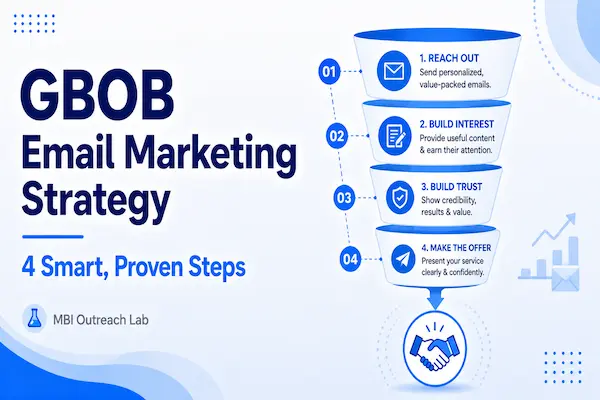
The 4-Email Drip Sequence
Space each email roughly 2-3 days apart. The sequence can flex between 3 and 6 emails, but four is a solid working default.
| Purpose | Goal | |
|---|---|---|
| 1. Wake-Up Call | Highlight the problem starkly, no pitch yet | Grab attention, provoke concern |
| 2. Awareness | Explain why the problem is happening | Build understanding, position expertise |
| 3. Common Mistakes | Show why most businesses get this wrong | Set up your service as the specific fix |
| 4. Solution + Story | Share a short case study, then a soft offer | Convert warmed trust into a reply |
⚠️ Watch for this: even in email 4, avoid an overtly hard sell — international audiences in particular respond poorly to direct pushiness. A soft, low-pressure offer (“happy to share a few relevant sites if useful”) consistently outperforms an explicit close.
The AI-Search Angle (Email 2’s Real Power)
Email 2 works best when it explains a genuinely current shift: search behavior is moving toward AI tools like ChatGPT and Google’s own AI Overviews, and traditional SEO alone no longer guarantees visibility. Concepts like AIO (AI Optimization) and AEO (Answer Engine Optimization) matter now alongside classic SEO — and the businesses AI tools trust are the ones with real authority signals: citations and mentions on credible, established sites.
This framing is more than a hook — it’s genuinely accurate, and it sets up your guest-posting/link-building service as the direct answer to a real, current problem rather than a generic “improve your SEO” pitch every competitor already uses.
💡 Pro tip: soften your language in emails 1-3. Save explicit terms like “guest post” or “link building” for the final email once some trust exists — earlier messages read better with softer framing like “authority placements” or “brand mentions on trusted sites.”
Why a Business Email Changes Everything
One credibility factor sits underneath all four emails: which address they’re sent from. Clients report a consistent pattern — outreach from a plain @gmail.com address often gets reported as spam without a second look, while the same message from a proper business email domain gets read and treated seriously. A business email doesn’t just look more professional; it signals that a real domain and business exist behind the sender, which measurably changes how the message is received before a single word is read.
📊 Why sequence quality compounds
Illustrative example, not a guaranteed outcome: a practitioner sending 1,000 cold-researched leads a direct pitch might convert a small handful per week — the outreach volume alone does the work. Layering the same volume through a 4-email drip sequence, with the AI-search framing in email 2, tends to lift that conversion meaningfully higher over the same period, since recipients are responding to earned trust rather than a cold ask. Volume still matters — sequence quality is what determines how much of that volume actually converts.
Common Misconceptions About Email Marketing Strategy
“More Emails in the Sequence Is Always Better”
Longer isn’t automatically stronger. Three to six emails is the effective range — beyond that, diminishing returns and fatigue set in.
“The Pitch Should Be the First Email”
This is the exact mistake a drip sequence corrects. Leading with the pitch before establishing any trust is why direct-pitch response rates lag so far behind sequenced approaches.
“A Gmail Address Is Fine as Long as the Content Is Good”
Content quality doesn’t overcome an immediate spam-report reflex. The sending address itself is part of the message, whether or not it should be.
“Mentioning AI Search Trends Is Just a Gimmick”
It reflects a genuinely real shift in how search and discovery work — using it accurately positions you as current and informed, not as chasing a buzzword.
Learn More: A 4-Step Cold Email Sequence for Agencies
A structured 4-email approach built for agencies — directly applicable to the sequence covered above.
Ready to Build Your Own Sequence?
Have questions about outreach sequences or setup?
Get in touch and we’ll help you think through your own email strategy and business setup.
Frequently Asked Questions
What is the best GBOB email marketing strategy for beginners?
A 4-email drip sequence — wake-up call, awareness, common mistakes, then solution with a soft pitch — consistently outperforms sending a direct pitch as the first message.
How far apart should drip sequence emails be spaced?
Roughly 2-3 days between each email works well — close enough to stay top of mind, spaced enough to avoid feeling like pressure.
Should I mention “guest posting” or “link building” early in the sequence?
Hold off until the final email. Softer framing in the first few messages (authority placements, brand mentions) reads better before trust is established.
Does a business email really make a measurable difference?
Clients report treating business-domain emails properly while reporting Gmail-address outreach as spam outright — it’s a real, stated behavior pattern, not a minor cosmetic preference.
Is the AI Overview/AEO angle just marketing hype?
No — it reflects a genuine shift in how search and discovery increasingly work, which is exactly why it resonates as a real, current problem rather than a recycled SEO pitch.
What’s the biggest mistake in email marketing strategy for outreach?
Pitching directly in the first message. It skips the trust-building step entirely and gets discounted the same way any unsolicited sales pitch does.
Final Thoughts
A strong GBOB email marketing strategy comes down to patience over pressure: build trust across a short sequence before ever asking for anything, use the genuinely current AI-search shift to make your pitch relevant, and send from an address that earns a fair reading in the first place. None of it requires more outreach volume — it requires better sequencing of the volume you’re already sending.
Related Reading
More from MBI Outreach Lab:
