
Reading about outreach is easy — actually landing your first placements is where most people stall. If you want to learn how to do blogger outreach the way professional link builders run it daily, this is the exact playbook: seven steps, real numbers, and the mistakes to skip. It’s the hands-on companion to our complete guide on what blogger outreach is — that one explains the model; this one gets you doing it today.
⚡ The 7-Step Process at a Glance
- 1. Set targets → 2. Build prospect list → 3. Vet every site → 4. Find verified emails → 5. Pitch short and specific → 6. Negotiate terms upfront → 7. Verify and log every placement
- Key numbers: authority score 20–60, traffic 1,000+/month, max 2 follow-ups, 30%+ reply rates from invite-page sites.
How to Do Blogger Outreach in 7 Steps
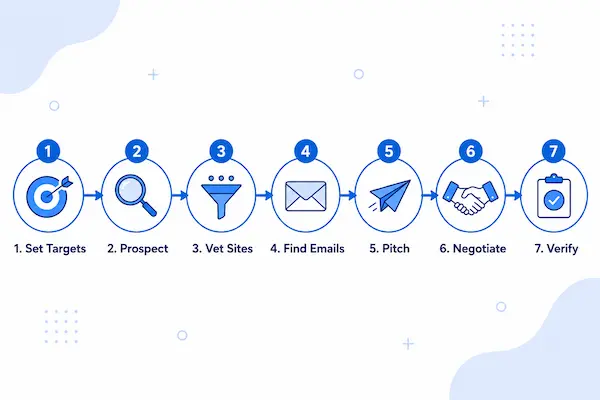
Step 1: Set Your Target and Success Criteria
Before touching Google, decide three things: which pages on your site need links (your money pages, usually), what anchor text mix you’ll aim for, and how many placements per month your competitors’ backlink profiles suggest you need. Pull the referring-domain counts of the top three pages ranking for your main keyword — that gap is your target. A campaign without a numeric target always drifts into “we sent some emails.”
Step 2: Build Your Prospect List
Two methods fill a list fast:
- Invite-page searches: Google your niche keyword combined with phrases like “write for us,” “submit a guest post,” or “become a contributor.” Sites publishing these pages are openly asking for content — which is why they reply at three times the rate of cold targets. Rotate both halves of the search (different invite phrases × different niche terms) and one niche can produce hundreds of unique prospects.
- Competitor backlink mining: pull the referring domains of a strong site in your niche with any SEO tool. Every domain on that list has already published a link for someone — proven, reachable publishers. One competitor can hand you thousands of prospects.
Step 3: Vet Every Site Before You Email
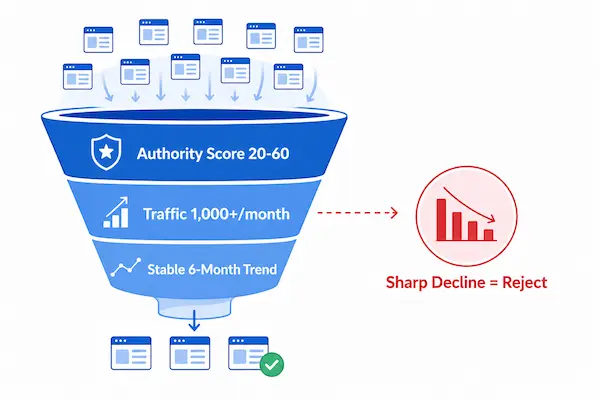
This is the step that separates a real campaign from burned budget. Run three checks on every prospect:
- Authority score in the 20–60 band. Below 20 the site is too weak to move anything; above 60 you’re in premium territory that needs a different approach entirely.
- Real organic traffic — 1,000+ monthly minimum, and check where it comes from: US, UK, Canadian, Australian, and European visitors carry more commercial value than traffic from low-cost regions.
- A stable or growing six-month traffic trend.
⚠️ Time-saver: check only the authority score and traffic at this stage. Run deeper checks (DA, DR, spam signals) later — and only on the sites that actually reply. Effort should follow responses, not precede them.
Step 4: Find and Verify Contact Emails
Look for a contact page, a “write for us” page with submission details, or the author’s email in the site’s about section. Where none exists, email-finder tools can locate and verify addresses from a domain or an author’s article URL. Verification matters: bounced emails hurt your sender reputation, and a damaged sender domain quietly kills every future campaign. Log each contact into your database next to the site’s metrics.
Step 5: Send a Pitch That Gets Replies
Editors skim dozens of pitches daily. The winning format is short, specific, and commercial-honest. Here’s the skeleton we use:
Subject: Guest post for [Site Name] — [specific topic]
Hi [Name],
Your recent piece on [specific article] covered [specific point] really well. I’d like to contribute a guest post on [topic idea] for your readers — original, well-researched, and written to your guidelines.
Could you share your guest post price and turnaround time?
Thanks,
[Your name]
That’s the whole email. One personalized line, one clear offer, one easy question. Long introductions, flattery paragraphs, and attachments all lower reply rates.
📊 From our own testing
In June 2026 we A/B tested pitches across 200 tech-niche prospects — identical offer, identical sites. The version opening with a specific reference to the site’s own article pulled 41 replies; the generic version pulled 19. One personalized sentence more than doubled the response rate. Personalization isn’t politeness — it’s arithmetic.
Step 6: Negotiate and Close the Deal
Before any content is written, get four things agreed in writing: the price (ask for both guest post and link insertion rates — you’ll want both options later), the link type (dofollow, nofollow, or sponsored — confirm it explicitly), the TAT (turnaround time until your article goes live), and a sample placement URL from the same site so you can see exactly how and where your content will appear.
💡 Pro tip: the sample URL protects you from the industry’s oldest trick — being quoted a “guest post” on a big site and receiving a cheap syndicated press release or subdomain placement instead. The URL structure reveals the truth before you pay.
Step 7: Verify, Log, and Follow Through
When the live link arrives, check three things: the link is present with the agreed anchor, it’s the agreed type (right-click → Inspect → look for nofollow/sponsored attributes), and the article gets indexed by Google (search site: plus the full URL). Then log everything — URL, anchor, metrics, price, date — into your outreach database. That sheet compounds: the second deal with any vendor is always faster and often cheaper than the first.
Watch: The Process in Action
A walkthrough of finding legitimate bloggers and structuring outreach — watch it alongside the seven steps above.
The Follow-Up Schedule That Doubles Replies
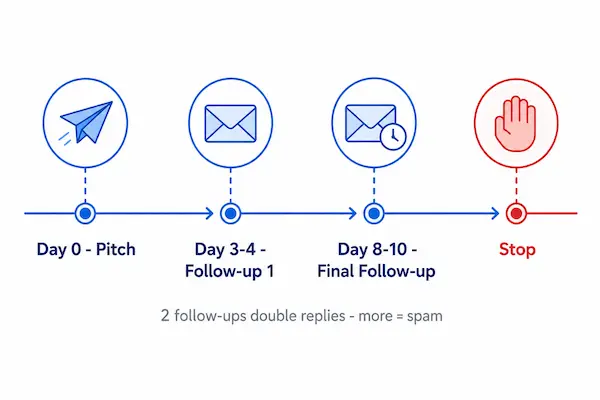
Most replies don’t come from the first email — but they also don’t come from the sixth. This cadence hits the balance:
| Day | Note | |
|---|---|---|
| Day 0 | Original pitch | Short, personalized, one question |
| Day 3–4 | Follow-up 1 | One polite line on top of the original thread |
| Day 8–10 | Follow-up 2 (final) | Close the loop: “happy to revisit later if timing’s off” |
| After that | Stop | A fourth email earns spam reports, not placements |
Two well-timed follow-ups can nearly double total replies. Anything past that trades a tiny chance of a placement for a real chance of a burned domain reputation.
The Free Tool Stack to Start With
You don’t need paid software for your first campaigns. A workable starter stack: Google search operators for prospecting, a browser SEO extension connected to a free SEO-tool account for on-SERP authority scores, a free traffic checker for the vetting step, an email finder’s free tier for contacts, and a spreadsheet as your outreach database. Upgrade to paid tools only when volume demands it — the process matters far more than the software, a point Google’s own SEO documentation makes repeatedly: fundamentals beat tooling.
When to Do It Yourself — and When Not To
Everything above is genuinely learnable. But budget honestly: prospecting, vetting, emailing, negotiating, verifying, and logging consume several hours per placement until your vendor database matures. If you’d rather have the placements than the process, that’s the exact gap our team fills — vetted vendor relationships, negotiated prices, and verified live links on a clear monthly plan.
Want the placements without the grind?
MBI Outreach Lab runs manual blogger outreach, guest posting, and link insertions — every link vetted, verified, and reported.
4 Beginner Mistakes That Kill First Campaigns
- Emailing before vetting. Beginners fall in love with list size and email everything. A 500-site unvetted list performs worse than a 150-site vetted one — and wastes money on junk placements when replies do come.
- Buying from the first reply. The fastest responders are often the most aggressive link sellers. Compare at least three quotes in each authority band before committing; prices for near-identical sites vary wildly.
- Ignoring the sender domain. Blasting 200 emails on day one from a fresh address lands you in spam folders permanently. Warm up gradually and keep bounce rates low with verified addresses.
- No records. Without a log of prices, contacts, link policies, and TATs, every month starts from zero. The database is the compounding asset — treat it like one.
We dissect the full failure patterns — including the ones that hit experienced teams — in our upcoming guide on why outreach campaigns fail.
How to Measure Whether It’s Working
Track four numbers from day one, because they tell you exactly where the process is leaking:
Reply rate (replies ÷ emails sent) — below 10% on an invite-page list means the pitch or the email verification is the problem. Placement rate (deals closed ÷ replies) — low here means pricing expectations or negotiation is off. Cost per placement — trend it monthly; it should fall as your vendor database grows and repeat deals kick in. Indexing rate (placements indexed ÷ placements paid for) — anything below roughly 90% means you’re buying on sites Google doesn’t trust, and the vetting filters need tightening.
Rankings follow with a lag — expect the first meaningful movement two to four months into a consistent campaign, which is why the monthly rhythm matters more than any single placement.
Frequently Asked Questions
What’s the fastest way to learn how to do blogger outreach?
Run a small real campaign: pick one niche, collect 50 prospects through write-for-us searches, vet them down with the authority and traffic filters, and email the survivors using a short personalized pitch. One month of doing beats six months of reading — the seven steps above are the exact sequence to follow.
How many emails should I send per day?
Start small — 10 to 20 personalized emails daily from a warmed-up address — and scale gradually. Sudden bulk sending from a fresh domain triggers spam filters and can blacklist your sender reputation before the campaign even starts.
Should I use my main domain’s email for outreach?
Many professionals use a separate but related domain for high-volume outreach to protect the main domain’s sender reputation. For low volumes with careful verification, your main domain is fine.
What is a normal response rate for blogger outreach?
Cold lists typically reply at 5–10%. Lists built from write-for-us and invite pages regularly cross 30%, because those sites are already asking for content. If you’re far below these numbers, the usual culprits are an unverified email list or a generic pitch.
How much should I pay per placement?
It varies by authority, traffic, and niche — solid mid-tier blogs commonly charge from a few dozen to a few hundred dollars. Always compare the quoted price against the site’s real traffic and always confirm the link type before paying. Full benchmarks are in our complete pricing guide.
Final Thoughts
That’s how to do blogger outreach from a standing start: set a numeric target, build and vet a real list, pitch short, negotiate the four terms, and verify everything you pay for. The process rewards discipline over cleverness — the campaigns that win are simply the ones that filter harder and follow up on schedule. Start with the definitions and strategy in our complete blogger outreach guide, run your first 50-prospect campaign with the steps above, and you’ll know more than most people selling this service.
Related Reading
More from MBI Outreach Lab:
- What Is Blogger Outreach? The Complete Guide for 2026
- How to Analyze Bloggers for Link Building & Outreach (coming soon)
- How Much Does Blogger Outreach Cost? 2026 Pricing Guide
- Why Blogger Outreach Campaigns Fail (coming soon)

Pingback: What Is Blogger Outreach? The Complete Guide for 2026