
Most guest post assignments start the same way: a client hands you one anchor text and one URL, and expects you to figure out what to actually write about. The instinctive move is to write directly about that anchor text — it feels efficient, since you already know the topic.
It backfires almost every time. A guest post written on the exact same topic as the client’s own target page doesn’t support that page — it competes with it in the search results. Done properly, GBOB keyword research avoids that trap entirely. This process is the one used internally at MBI Outreach Lab on live client campaigns, not a theoretical framework.
Quick Summary
- Start from the client’s exact anchor text and target URL — never improvise a topic before you have both.
- Search that exact phrase on Google and mine the “People Also Ask” and related-search panels for nearby topics.
- Reject any topic the client’s own page already covers — that overlap is exactly how a guest post ends up competing with the page it’s meant to support.
- One target URL needing five guest posts needs five different adjacent keywords, not the same keyword written five times.
- A quick look at who already ranks for the client’s real keyword tells you how much backlink strength the campaign actually needs.
Keep the client’s exact keyword and URL — just never write your guest post about them directly. That single rule is where most guest post keyword research goes wrong.
What Is GBOB Keyword Research?
Short answer: GBOB keyword research is the process of finding topics closely related to a client’s target keyword and page — without directly duplicating them — so a guest post can link back to that page naturally, instead of competing with it in search results.
Most keyword research advice is written for someone building their own page’s authority from scratch: find volume, check difficulty, chase content gaps. That advice assumes the page you’re writing is the page you want to rank. Guest post keyword research has a different goal entirely — the page you’re writing is never the page that needs to rank; the client’s target page is.
Step 1: Get the Exact Anchor Text and Target URL First
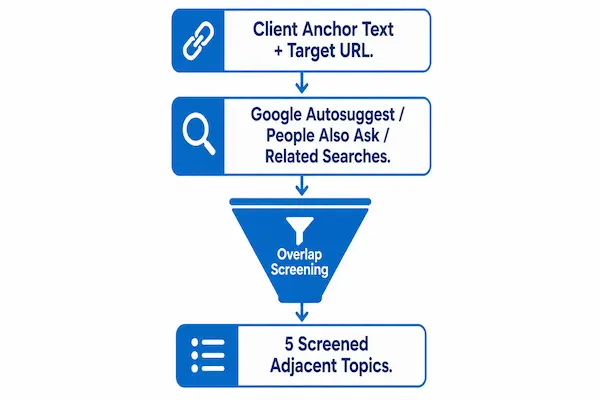
Before any research starts, get two fixed inputs from the client: the exact anchor text they want used, and the exact URL it should point to. Both stay fixed through the whole process — what changes is the guest post topic built around them.
Step 2: Search That Exact Phrase on Google
Take the client’s anchor text and search it exactly as given — don’t paraphrase it. The point isn’t to read the results; it’s to trigger Google’s own related-query features around that phrase, which is where the real candidate list comes from.
Step 3: Mine Autosuggest, People Also Ask, and Related Searches
Google’s autocomplete and related-search features exist because they reflect what real people actually search for around a given phrase. According to Google’s own explanation of how autocomplete predictions work, these suggestions come from real, aggregated search activity — not guesses — which is exactly why they’re a reliable place to find genuinely-searched adjacent topics.
Say a client’s anchor text is about the requirements for registering a trademark in a given country. Scrolling the People Also Ask box and the related searches for that phrase might surface things like “how do you register a trademark,” “why is a trademark needed,” or “what is a trademark registration certificate.” Each sits near the client’s topic without answering the exact question their page already answers.
Step 4: Screen Every Candidate — Overlap, or Complement?
Not every autosuggest phrase is safe to use. Some cover ground the client’s own page already covers in detail — using one just recreates the competition problem you’re trying to avoid. Run every candidate through these five checks before it makes your list.
| Signal to check | Question to ask | Reject if… |
|---|---|---|
| Topic overlap | Does this topic answer the exact same question as the client’s page? | Yes — it’s a duplicate, not a complement |
| Search intent | Would someone searching this phrase be fully satisfied by the client’s page instead? | Yes — same intent, same competition |
| Natural link fit | Can the client’s exact anchor text be worked in without forcing it? | No — the link will read as an afterthought |
| Cross-post uniqueness | Has this topic already been used for another guest post to the same URL? | Yes — it will cannibalize the other guest post |
| Real search behavior | Did this phrase actually appear in Google’s autosuggest, PAA, or related searches? | No — it’s a guess, not a verified search term |
A topic only earns a place on your list if it clears every row. One overlap is enough to disqualify it.
Step 5: Repeat Per Guest Post, and Size Up the Competition Once
If a client wants several guest posts pointing at the same URL, each one needs its own adjacent keyword, title, and anchor-text context — never the same topic recycled. This keeps guest posts from competing with each other, not just with the client’s page.
It also helps to check, once, which sites currently rank on page one for the client’s actual target keyword, and get a rough sense of their backlink profiles. That single check shows how much backlink strength the campaign realistically needs before it can move the client’s page.
Common Misconceptions About GBOB Keyword Research
“More keywords always means a stronger campaign”
Volume of keywords means nothing if half of them overlap with the client’s own page. Five properly screened topics outperform fifteen unscreened ones, because unscreened topics quietly compete with the page they’re supposed to help.
“A keyword tool will screen these for you automatically”
Volume and difficulty tools tell you if people search a phrase — they don’t know whether that phrase duplicates a specific client’s specific page. The overlap check above is manual judgment, not something a tool outputs on its own.
“The client’s own keyword is fair game to write about directly”
It’s the opposite: the client’s exact keyword is the one topic you should never write the guest post about, precisely because it’s the topic their own page is trying to own.
“Checking competitor backlinks is optional extra work”
It’s a five-minute check that tells you whether the campaign needs three guest posts or thirty. Skipping it means guessing at campaign size instead of sizing it to the actual competition.
Watch: Guest Post Keyword Research in Action
Paste this URL into a WordPress Embed/YouTube block (or Elementor’s Video widget) — do not use raw iframe code, it gets stripped for non-Administrator accounts.
Contact MBI Outreach Lab →
Frequently Asked Questions
What is GBOB keyword research?
It’s the process of finding topics adjacent to a client’s target keyword and page, so a guest post can support that page with a natural link instead of competing with it for the same search results.
How is this different from normal SEO keyword research?
Normal keyword research aims to rank the page you’re writing. Guest post keyword research aims to support a different page — the client’s — without duplicating its topic.
Do I need a paid keyword tool for this?
No. Google’s own autosuggest, People Also Ask, and related-search panels are free and sufficient for this specific use case — the goal is finding a handful of adjacent topics, not modeling exact search volume.
How many keywords do I need per client?
One per guest post the client wants. If they want five guest posts pointing at one URL, you need five different, screened adjacent topics.
What if the client already gives me keywords?
Some clients, especially agencies, hand over pre-researched topics. Run them through the same overlap screening anyway before writing — it costs a few minutes and avoids duplicating their content unintentionally.
Can I reuse the same guest post topic for multiple clients?
Only if the underlying anchor text and target page genuinely differ enough that the adjacent topic still passes the overlap check for each client separately — don’t copy a topic wholesale between unrelated clients.
How do I know a topic is actually safe to use?
Run it through all five checks in the screening table above. If it clears every row, it’s safe. One failed row is enough to drop it.
Done consistently, GBOB keyword research turns a one-line client brief into a screened list of topics you can hand to a writer with confidence — no guessing, and no guest post quietly competing with the page it was supposed to support.
